Wednesday, June 7, 2017

Discovering the Formula for Area of Trapezium


I was thinking of writing the 2nd part of Fraction story tonight....But did not know that something more interesting would emerge in our class today.... :)

It was completely unexpected as there was nothing that we were doing on geometry today..

Rohit walked up to me asking for a method to find the Area of hexagon... I just hinted him that a hexagon can be sliced into triangles, and that we had already 'discovered' the formula for area of triangle... He looked at me for a while and then left, while I too got engrossed with my work...

Soon, I heard him talking to his peers - "I still need to find the formula for area of trapezium. Its pending since long..."

I turned around to find him trying out some constructions around a trapezium, drawn on the floor. I usually don't disturb my students when I see them doing such research. However, I desperately wait for the moment to be invited by them to see their work...Why? - Because it's an authentic learning source as well as opportunity for me!

This time I am trying to share the story in a different way... I will just share the photos of the work of the student as he continued with his work.. I will allow you to figure out what's going on the floor and even in his mind :-)

But before we embark on this game, I invite you to solve a problem --

1) Forget the formula for Area of trapezium, (if you still remember it :) And
2) Try to find its formula using any method that makes sense to you.

The only rule is -- you cannot use any rule or formula whose derivation/ proof you are not aware of or you don't understand... In short, your work should be based on Understanding and not rote-learning of the knowledge that you will be using..  This is the rule we follow in our class...

Ready?  :-)

Take enough time.. 

Don't worry..... there is no race in our class :-)

And when you are done......

You can scroll down to see the approach of Rohit.....

....

....

....


So...... How was it?   :-)

I don't know about you friends....  But let me make an honest confession... Despite being a person who enjoys learning and exploring about many ways to solve the same problem, I have still not thought of or came across this particular innovative method of finding the formula for area of trapezium..... He just won my heart.... !!

-- What are your views about this method?
-- What was your method? (Was it different than the method taught to you?)
-- Why do you think was Rohit able to find out this method?

Would like to hear your response to these questions :)


PS: Rohit has just passed his class-7 from a marathi medium municipal school and lives in the slums surrounding his school, with his parents and younger brother. He loves maths very much and is part of the program - MENTOR.  To know more about this program, check the website www.supportmentor.weebly.com


Rupesh Gesota

Wednesday, May 31, 2017

Finding a number between 2 fractions : Part-1


To gauge their conceptual understanding of fractions, I asked a problem to a bunch of 10th std. private school students --

"Write a number between 2/5  and 9/14"

Sadly (or rather not surprisingly) none of them could answer this problem correctly, in fact most of them had not even attempted it. (Why?) 

I would however like to share one of the solutions --


What are your views about the way this student has solved this problem?  Is it correct or not? Why? 

While I was correcting their answer papers, my regular students (sixth standard municipal school ones) were around me working on their assignments. I thought that this problem would be pretty simple for them. Still, I gave it to two of them to study how they see and solve this problem.

Vaishnavi's approach:  She converted 2/5 into its equivalent fraction with numerator same as that of 9/14. (Conventional maths teachers might want to read this sentence again :)

2/5 = 2x4.5 / 5x4.5  = 9 / 22.5

So now the game was easy for her.

"Now, we want to find a fraction between 9 / 22.5   and 9 / 14. So it is 9 / 14.5"

What do you feel? Is her answer correct?  :-)

While Jeetu was still figuring out his way, I included him in this process and asked him if he agreed with this approach and answer. He studied the solution carefully and gave a thumbs-up. 

The trouble-making teacher in me pushed her further. I don't like to see decimal points in fractions.

And she immediately replaced the fraction 9 / 14.5 with 18 / 29.

" Can you find a fraction between these two fractions now?"

She gave me a puzzled look, "Which two fractions?"

18 / 29 exists between 2 /5 and 9 / 14.  Now find a number between 2 / 5 and 18 / 29

Same as previous one, she converted 2 / 5 into its equivalent 18 / 45.

" 18 / 30 is a number between 18 / 29 and 18 / 45."

While I was still studying her solution - wondering about the next level of challenge, she as if read my mind and -- 

"Now you will tell me to find a number between 2/5  and 18/30, isn't it?"  :-) :-)

"Nope...I know this is easier for you now... So now, I want you to find a number which lies exactly mid-way between 2 / 5 and 18 / 29."

Now I told both of them to work independently, and I observed what both of them were doing.

Contrary to her previous approach, this time Vaishnavi was trying to make both the denominators same rather than numerators. What do you feel, why would have she changed her strategy this time?

2 / 5 = 58 / 145

18 / 29 = 90 / 145

And after doing some scribbling, she said  "Sir, the required number is 74 / 145"

This is how she had written finally --

58 / 45    ,    74 / 145     ,    90 / 145

All this research was happening on the floor with chalks and a cloth (duster). Unfortunately, my phone's battery betrayed me and I could not take any of the beautiful snaps.

"How do you know your answer is correct? Did you verify using other way?"

She thought for a moment and then brought the calculator from the drawer. I was happy. (Should a calculator be allowed in the school? :-)

This gave me time to look at Jeetu's work. He too was ready with his answer by then.

"Sir, the required number is 18 / 37"

He had written these 3 numbers one after the other.

18 / 45   ,     18 / 37    ,     18 / 29

Wow! I get super-delighted when my students' answers look different....

Hey wait !!  Aren't you wondering what kind of crazy maths teacher I am? Won't a maths teacher want all his students to have the same answer and probably using the same (standard) method? :-) 

"Ok. But then Vaishnavi's answer is different than yours. How do I know what is correct?"

(If you observe, I did not ask - 'Who' is correct? I asked 'What' is correct? Do the words we use consciously/ unconsciously in our maths class make any difference towards building the math mindset of our students?)

He got engrossed in studying his solution. Meanwhile, Vaishnavi was doing the number crunching on calculator. After a minute, she screamed --

"Sir, my answer is correct."

She started explaining. "The calculator gave me the decimal representations of the two fractions 2/5 and 18/29. Using these two decimal values I calculated their mid-point which was also in decimal form. This was found to be equal to the decimal form of my answer (i.e.  74 / 145 )"

Are you satisfied with her approach?

"Ok..  But what if your method to find out the mid-point itself might be incorrect? After all, you have used the same method for vulgar fractions as well as for decimal fractions."

She thought for a while and then replied with a confident voice -- "No sir, my method for calculating mid point is correct. We have used it many times in our class."

"Oh.. is it?  Can you explain?"

"I first found the difference between 58 and 90. Then added half of this difference to 58 to get their mid-point 74."

Did you get what she said? Is it the same way we have been 'taught' to get the mid-point? or were we taught some 'standard' method?

I asked Jeetu for his opinion on her method. He agreed and even confessed that he too has used the same approach to find the mid-point of 29 and 45 to get 37.

"I know a little easier & faster method to find the number half way between the two numbers. Can you think of that?"

After a while, Vaishnavi exclaimed -- 

"Do the half of both the numbers and then add them."

I was like Wow... She got it...!!

Jeetu wore my cap.. He questioned her... "How do you know?"

"I just guessed... and it works in couple of cases I tried..."

Jeetu looked at me for my views.... 

"Why are you looking at me? Why don't you verify?"

He tried few cases and found it working....

Vaishnavi started flying with her discovery.... but soon I brought her back -

"Hey,,,wait... your job is not yet done.... You also need to "prove" your method now....."

So both of them started thinking about the proof now.... When I saw that they were unable to take ahead, I intervened.

"Can you express your method in mathematical form for any two numbers a and b?"

They wrote it immediately --

(b-a)/2  + a        .... assuming b > a

"Is it possible to simplify this expression?"

Vaishnavi wrote   b/2 - a/2 + a    but both of them were surprisingly unable to take this ahead. So she just wiped it away  (and my heart sank !! :-(

Jeetu then directly wrote    (b - a + 2a) / 2

While he was continuing further, I stopped him -- "What have you done?"

He explained, "Sir, we have to add 'a' after dividing (b-a) by 2. So if we want to take 'a' inside the bracket with (b-a) then we will have to first multiply it by 2 and then put it inside the bracket."

Did you get this explanation?  :-)  Tell me honestly, what was your method?  
Hmmm....Let me guess -- It was either cross multiplying or making both the denominators common, isn't it? :-)

"Ok.. go ahead..."

"we are subtracting 'a' and adding '2a' so this becomes

(b+a)/2

"Done.. we cannot simplify this further.."

"Hmm.... Actually you knew this method. But you did not apply it here."

They were puzzled ....  After a while Jeetu sparkled --

"yes sir... If I have some pebbles and you have some pebbles.... and if both of us need to have same number of pebbles, then we will first put them all together and then just halve it.."

I looked at Vaishnavi for her nod ---  "It was so simple.... In fact, I can even see my method existing here....."  and while saying this, she simplified (a+b)/2  to a/2  + b/2    :-)

"Why is this method easier and faster than your previous method?"

Jeetu said -- "It requires just two operations rather than three operations in our former method.. So even lesser chances of error..."

And we now shifted our focus back to the original problem now ---

Which answer is correct  --   74 / 145     or   18 / 37

Vaishnavi was confident about the accuracy of her answer because she had verified it using calculator, and hence I could see her not taking the responsibility of solving this 'new' problem of which answer is correct...

However it didn't take much time and effort for me to motivate her to get engaged in this problem solving / fault-finding process...

Jeetu thought for 5 minutes and then said -- "Sir, I feel my answer is not correct... Vaishnavi's answer is correct...  2/5  is less than half  and  18/29 is more than half.....  Her answer i.e.  74/145 is close to half......"

Vaishnavi responded -- "Even your answer  18/37 is close to half... even that can be correct.."

I was glad to find that Vaishnavi had started analyzing Jeetu's answer and could see some sense even in her peer's work...

-----

Well, I can see that this post has already grown quite a lot and hence I would share the further story with you all in the next -- Part-2 -- of this post....   :-)

Meanwhile, I will be happy to ---

a) know your views/ opinions about the way maths is done with students in this post..
b) read your answers to the questions asked in blue in the post...
c) How would you solve this problem?
d) What would have you done if your child or students would have solved this problem differently than the way you solve or expect?
e) What do you feel what would happen in the 2nd part of this story i.e. how will we/ they decide which answer is correct ?

Waiting for your reply  :-)

Friday, September 23, 2016

Playing with Fractions: Part-2

Hello friends,

Yes, I know I have delayed quite a lot in posting this Part-2. So then, what motivated me to sit for it today?

One email reminder from a teacher and one WhatsApp message from a parent inquiring for the follow-up post on Fractions. It was also so encouraging to know from them and other teachers about the discussions they had in their class about the comparison of the fractions after reading my post on fractions. Super-satisfied !! 

If you have been yet unable to read the previous (Part-1) of this conversation on fractions, I would suggest you to do so before you read this second part: This is the link:
http://rupeshgesota.blogspot.in/2016/09/playing-with-fractions-part-1.html

Even I had to first read this first part to recollect the incident and sequence of conversations.

So where were we?

Sania and Rohit had done some fraction comparisons/ estimations in a fantastic way... And I had now pushed them further to solve another problem visually/ mentally without using any conventional procedure for simplifications.

This was the question posed to them:
"Fine, let's get back to the last problem then....Is  3/7 + 2/3 greater than or less than 1?"

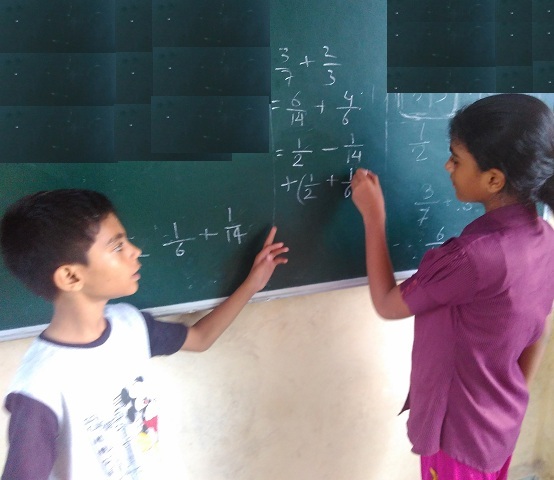
This is how their work looked like after some time:


If you notice, 

a) Sania had figured out the equivalent fraction of 2/3   i.e. 4/6   (what must be going on in her head?)

b) Can you understand what Rohit has done?  :-)

...
...
..
...
...

He is still working on 3/7.. .. But he has decomposed the other fraction 2/3 into its two parts : Half and the Remaining part... Can you identify which is Half and which is the Remaining part from those two fractions?

Also, take some time to digest and even appreciate the creativity and flexibility of this young chap!  :-)

Meanwhile, Sania had converted the second fraction 3/7 to its equivalent form as before. Not just that, she also explained me that --

"Sir, 3/7 is less than Half by 1/14"


I noticed that Rohit was still struggling with 3/7.... In fact, I was surprised... He had already decomposed 2/3 , then what was stopping him to work out similarly for 3/7?

So I decided to get these two minds together...... Because -
Sania had found the relation of 3/7 with Half   AND
Rohit had expressed 2/3 in terms of (strange looking) Half plus something.


So both of them share each others' work so far... After some discussion, I instruct them to start writing the solution systematically by combine their observations on 2/3 and 3/7.

So here they go ---


And after some time, 
...
...
....

Though they had understood the relations between 3/7 and half (i.e 6/14) as well as  2/3 and half (i.e. 3/6), it was not so easy for them to substitute these expressions for the original fractions.. I had to do some scaffolding..

You can see some work on the top of the image(board)

When they were struggling to represent 6/14 as 1/2 - 1/14 in the third step, I asked them how can they write 8 in terms of 10?

Can you see how they have added the two Halves to make 1. I was so glad that they did not get 'lost' in the mess (of four fractions :-)

Yes, they were again a bit stuck up at the last step i.e. 1 - 1/14  + 1/6

What did I do at this instant? Teach them? Explain them? ...... No!

The art of teaching is not in explaining or giving answers but in asking right questions !

Notice the top of the image again... This is what I wrote:

20 - 2 + 8

"What will happen to 20 - Will it increase or decrease? Can you tell this to me without calculating the exact answer?"  .... (Why would I ask such a question?)

So this question hinted them that they now needed to compare the two little fractions after 1. And they did this correctly.... Again, I was very happy that they did not say 1/14 > 1/6 (something that 10 out of 8 students generally say... Oops, I mean 8 out of 10 students :-)

So then?  The road ahead was easy for them..

This was their final stroke --

"Sir, since we are subtracting a smaller number (1/14) and adding a bigger number (1/6) to 1, the final effect would be to increase 1."

Would wait and love to know your views and comments on this post :)

Thanks and Regards
Rupesh Gesota


PS: The above conversation happened not in English, but in Marathi, because the students belong to marathi-medium government school (from challenged socio-economic background) with whom I work regularly... 
Check the website: www.supportmentor.weebly.com to know more about this program -MENTOR. There's a short video-clip on its homepage.

Wednesday, September 7, 2016

Playing with Fractions: Part-1

Hello friends, 

Thank you so much for liking my previous post & even posting your wonderful comments & views on it...
  • Thanks for sharing. I love to "see" teachers in action helping kids learn in their own!
  •  Very nice ! That's the joy of discovery  We do not need robots to memorize everything on tips, we need discoverers !!
  • An interesting read to let the child learn by analysis of his own possible answers..Needs loads of patience on the part of teachers! Doing a wonderful job..keep it up
Those who have missed it, here's the link for you: 
There's seem to be some problem in Table of 15..
http://rupeshgesota.blogspot.in/2016/08/there-seems-to-be-some-problem-in-table.html
-----
I have been asked about Fractions by people quite often...

Few months back, I had shared my experience of working with a student on Fractions, which was quite appreciated by teachers, parents and even teacher educators. Here it is:
Playing Maths: "It is Half... No, it is 1 Upon 6... No, it is Half... No,it is...."
http://rupeshgesota.blogspot.in/2014/11/playing-maths-it-is-halfno-it-is-one.html
-----
Okay...Something very exciting happened in our class today too (Yes, on Fractions!) and so, I cant wait to share this with you :)

Assessments were done and I was checking their answer papers.....I noticed that a student had used an interesting approach to solve a Fraction Estimation problem that I generally ask to every middle and high school student.....Two other students were working on a math puzzle next to me and so I thought to try this problem with these students... I was curious to know how they would see and solve this problem.

Question:   Is   ( 9/12  +  1/5 ) greater than 1 or lesser than 1?

I wanted them to solve this problem together and mentally... But they -- Rohit and Sania -- spread out on the two extremes of the blackboard to work out on their own...

Before you look at their work, I would suggest you to solve this problem, on your own :)

.....
....
.....
....
....
....
....
....
....
....

And this is how their work looked like......... after about 2 minutes:


What did you observe?

Let me guess...

1) You were absolutely shocked with the approach used by Rohit, isn't it?  :-)  :)
  
2) Sania's method being familiar to you, might not surprised you much...

But Hold On !!  
  • What if I tell you that -- I have NOT taken any special effort/ class to teach them the "rules or procedure" to add/ subtract the fractions with unlike Denominators? 
  • We have rather spent enough time in understanding and visualizing the fractions and equivalent fractions. 
  • We do some fraction arithmetic, but occasionally, and that too in an unconventional / completely informal way whenever we require it in the problems that lead to fractions (of course, not the boring and easier text-book problems :-)

After knowing this background, you would be surprised even with Sania's method, isn't it? :)

Further, when they were asked for explanations, both of them reasoned beautifully -- it was difficult to add the 2 fractions with different denominators, so they tried to make their denominators same... The sum of 2 fractions is less than one because: 

-  a number is divided by the bigger number (by Sania, while referring to 57/60)

-  when both Nr. and Dr. are same, it is whole & here Nr. < Dr. (by Rohit, while referring to 11 2/5 / 12)

I couldn't resist my urge and had to ask Rohit --

"So how much more is needed to make the sum whole?"

"Sir, we need 3/5 more to convert this into whole! 11 2/5  + 3/5  = 12."

Then I asked them to study the method of their peer... They understood each other's approaches...

I asked Sania - "Do you know what have you done with the two denominators?"

"Sir, I have made them equal..."

"Yes, true.... But how did you get the number 60?"

"Since 12 could not be expressed as an integral multiple of 5, I needed another number that was multiple of both 12 and 5.... So I took 60..."

"Hmmm..... Can you see some relation between 12, 5 and 60?"

After studying them for a while, " Sir, 12 x 5 = 60....."  There was a sparkle in her eyes!

"Did you know that just multiplying them would give you the desired multiple?"

"No..."

"Can there be number other than 60..?"

"Ummm....... . 120.....?"

" Yes.... One more?"

"....180...."

"So what are you doing? What's happening?"

"Sir, 60, 120, 180.... all the multiples of 60 would be multiples of 12 as well as 5..."

"True... So what's special about 60?"

Rohit intervened -- "Sir, it is the Lowest Common Multiple of 12 and 5..."

Again, there was a big surprise and then even smile on Sania's face :-)

I was desperate to hear this jargon (LCM) from their mouths..... It was such a deep satisfaction to see these students 'Discover' the rule which is unknown (not explained) to most of the students...

"So how would you solve this problem now....  Is  3/7  + 2/3  bigger or smaller than 1?"

Both of them had resorted to the same approach now (making both Dr. equal) :


After working out --

"Their sum is bigger than 1 because 23 > 21"

Though they had impressed me enough, however I wanted to raise the bar...

"Now, can you solve this problem without pen and paper.... I mean, without any kind of simplification that you have just done?"

They gave me a blank face. I understood, that they had not got my question.

"I want you to just estimate their sum, and not calculate their exact sum."

Still a blank face....

"Okay... What if I ask you --- Is 48 + 29 less than 1000 or more than 1000 ?"

"It is more than 1000" - a loud chorus reply.

"Hmmm... Did you actually add 48 and 29 to get this answer?"

I wanted to hear 'No' but what I instantly heard from Rohit was "Yes Sir, I got the question.."

We looked at Sania for her views... After thinking for a while, she was with us.

Rohit - "Sir, 3/7 is smaller than Half."

"How do you know this?"

"Because 1/2 = 3/6 and in 3/7, we have divided 3 by 7 i.e by a number bigger than 6... 
Hence 3/7 < 3/6    i.e.  3/7 is lesser than Half..." 

I looked at Sania.... "Yes Sir, I agree with Rohit..."

"So what next?", I probe Rohit.

"2/3 is bigger than Half because of the same reason (2/4 = Half)"

"okay.... So what can we conclude about their sum?"

"Sir, it's difficult to predict.... One is bigger and the other is smaller than Half..."

I ask Sania -- "What's the problem Rohit is talking about?"

"Sir, he is right... We don't know how these two fractions will add up... Their sum might be bigger or smaller than one.."

"In what case, it would be easier for us?"

Rohit -- "If both were bigger than half or lesser than half, we can easily predict....."

"Hmm... Good thinking..."

I could have probed them further to do the analysis for this kind of problem; however, for some reason I drew their attention to the very first problem....

"Will you be able to solve the first problem mentally?"  (i.e Is  9/12 + 1/5  > 1 )

Rohit looked at the fractions and - " No Sir, here also we face the same problem."

"Plz explain..."

"9/12 > 9/18 i.e. It's more than half....&... 1/5 < 1/2 i.e. It's less than half...So we can't decide here as well.."

 "What if we replace the fraction 9/12 by 9/17?"

I write this problem on the board  9/17 + 1/5.... (why did I do so?)

"Sir, here too it's the same problem.... 17 in the Dr. < 18.... If it were more than 18, then this fraction too would be smaller than half like the second one; and their sum would be less than one. But in the given case, we can't say anything.."

"Hmmm......Okay..."

It was high time for me now and I wanted to push them to think beyond their opinion - 'it is not possible to tell in these cases'...

So I thought of a strategy and bounced back on them -

"I know that you have noticed that the two fractions are smaller and bigger than half.... Is it now possible for us to determine the quantity by which they are smaller or bigger than half?"

It was interesting to watch them at this juncture; it seems they had not thought of this idea earlier.

So now, they again went back to their islands, but this time I found them engrossed in just looking at the original two fractions (9/12 and 1/5)... It was a visual delight to see my students meditating in maths !! 

After some time, Rohit started scribbling something on the board. On probing, he answered-

"Sir, 9/12 = 6/12 + 3/12.......  i.e. 9/12 is 3/12 more than Half."

"Ok.."

"But then 3/12 = 1/4....  and............ 6/12 = 1/2..........."


Yes !!!  I was waiting for the bulb to glow now !! :)

"Sir.... then 9/12 becomes 1/2 + 1/4 = 3/4.... It is three-quarters !!"  

I could see him shocked at this revelation, as it was least expected by him...

"What surprised you so much Rohit?"

"Sir, I did not know that 9/12 is same as three quarters! "

"Hmm.... you know that's the trap I lay for students..." I exclaimed this proudly and continued -- " Can you now justify as to why 9/12 = 3/4 ?"

"Yes Sir... It is just the simplified equivalent fraction of 9/12.... I feel stupid I did not realize this before... "  

Surprise, Embarrassment, Joy  --- I could feel all his these three shades at this moment.


"Okay.. let's move ahead.... "

He thought for some time and soon gave a fantastic reasoning that I was dying to hear !!

"Sir, now 9/12 = 3/4.....  And we are adding 1/5 to this 3/4......... We know that 3/4 needs 1/4 to become whole...... But we are adding only 1/5 to it, which is smaller than 1/4....... and hence their sum would be less than whole....."

Take some time to digest this explanation and even appreciate this rare reasoning !  :-)

"Good one... Sania, what are your views on this?"

I had ensured that she was witness to our conversations so far. She agreed with Rohit. But I assessed (& ensured) her understanding by asking her couple of questions for my satisfaction.

"So now... Tell me.... Which method of analysis did you like more - the earlier one or this new one?"

Both of them voted for this Mental/ Visual method. !!

"What about our little modified version then :   9/17 + 1/5 ?  Will their sum be > 1 ?"

I wanted them to answer this problem instantly now.... (why so desperation?) 
(See if YOU can you answer instantly?)

But I was surprised that Rohit stayed mum this time... In fact, both of them were silent for about 20-30 seconds... It was getting hard for me to curb my urge to intervene...esp. after seeing them shine few seconds back....


I switched to Sania this time...

"Yes Sania, what do you feel?"

With little reluctance and low volume -- "Sir, it should be smaller only naa?"

Wow! It seems she had cracked it... But then why is she not confident ....?

"Go ahead dear.... Plz explain why?"

"In this case we are adding the fraction 9/17 to 1/5........  
Now, 9/17 is already smaller than 9/12...... 
So, if 9/12 + 1/5 < 1, then 9/17 + 1/5 should also be < 1......."

I was so glad that she could do what I was yearning for !!

"Good one!!  Rohit, do you agree with her views?"

"Yes Sir, I too was thinking on the same lines..."

"Fine, let's get back to the last problem then....Is  3/7 + 2/3 greater than or less than 1?"

And if you feel that this problem too was solved in a similar way, then please Hold on friends.... We had much more fun and acquired more learning in solving this last part as compared to the previous problems.....  (how come?)

But it's 2 hrs past midnight now and even this current post has grown quite longer... So, I will share the interesting climax of this story as Part-2 of this post in couple of days..

Please let me know your views, experiences, suggestions and reflections, on this post... You may also share with me as to how You and your students / children would see and solve these fraction estimation problems.. I would love to know from you.....

See you soon....   :-)

Regards
Rupesh Gesota

https://www.facebook.com/rupesh.s.gesota
https://www.facebook.com/program.MENTOR/

PS: The above conversation happened not in English, but in Marathi, because the students belong to marathi-medium municipal school (from challenged socio-economic background) with whom I work regularly. Check the website: www.supportmentor.weebly.com to know more about this program - MENTOR. There's a short video-clip on its homepage.