Sunday, February 27, 2022

Students make / extend the squaring trick :)

While playing with the square numbers, as to how can we find the square of numbers using the square of other numbers in various ways, we figured out the extension / modification of a well-known trick, something which was completely new for the teacher too :)

But before we go ahead, I would like to thank you all who read & even responded to my previous post with your lovely comments & thoughts. That was quite encouraging. In case you are the one who has not yet read the previous post, then I would recommend reading that first before this 
http://rupeshgesota.blogspot.com/2022/02/getting-into-algebra-through-arithmetic.html

Almost all students were aware of the 'trick' of finding the square of number ending with 5, thanks(?) to their teacher who had directly fed them this technique.

In case you are unaware of this technique then this is a good opportunity for you to figure out on your own. I have seen even few grade-4 students been able to do so, and pretty quickly :-))
Check the image given in the end of this post for your help !!

So after allowing them to impress me with this trick for few such numbers, I challenged them for the square of little different numbers like 48. And most of them, as I had expected or rather wanted, said:2064  (Do you get this, how they guessed this number?)

But when I asked them to verify their guess, they realized that its incorrect & they soon concluded (after trying for few other numbers like 29, 63, etc.) that the trick (quick method for finding the square of no. ending with 5), does not work with all the numbers.

So after this discussion / conclusion we had then moved to the other exploration (mentioned in detail in the previous blog post) and once we were done with that, one of the students told me that we can find the square of number ending with 6 by modifying the trick for the one ending with 5. And I was like highly. surprised with this claim. . Was she thinking over that one for this whole span?  And secondly I was also very curious now. Because I had never thought of / was unaware of this 'modification' till now.

She said, " We need to do some addition after applying the same method as that of 5."
She explained this with an example...

Let me share an image with you, allowing you to figure out what she did. Would suggest you to study this before you read the explanation below.


So yes.. This did intrigue me very much.... And hence we all tried our hands with various numbers. As you can see below: ..


Students also got excited looking at this method. And they quickly started trying numbers ending in 8 & 9 too... And their guesses to these did work. 

I hope some queries must have come to your mind by now :)

1) What about numbers ending with digits less than 5?
2) What is the explanation for this trick / method / algorithm ? [proof]

Well, these students did work on the 1st question and could crack it. However second question was just posed to them as of now so that they become aware of this possibility or rather necessity in Mathematics. 

In fact some of them became more curious to know the explanation now :)

-------------

Some questions I wish to ask you:

1) Were you too aware of this particular trick (esp. the modification/ extension) ?
2) If yes, then nice.... If no, then what was your reaction to this one, and esp knowing that it got discovered by a student :) 

I would be happy to know your response to these questions and any other comments / thoughts on this post.

And yes, as mentioned in the beginning of this post, here is the image to help those who wish to find the trick for squaring the numbers ending with 5.


Thanks & Regards
Rupesh Gesota

PS: These session are with a bunch of government school students from disadvantaged economic background, as a part of maths enrichment program MENTOR run with them. More details can be found here: www.supportmentor.weebly.com

Thursday, February 24, 2022

Getting them to Algebra via Arithmetic - 1

So by now, we (maths teachers) would most probably know many (or at least a few) ways to make students 'discover or arrive at' (& not simply teach / give away) the formula of Difference of Squares i.e. 

a^2 - b^2 = (a-b) (a+b) 

I too am aware of few interesting entry points to achieve this, but I was a bit surprised (at least in the beginning) when I realized midway during the 2nd session - while recording the 1st session's discoveries done by the students on the board - that this content can also be easily led to the above formula,.... and hence I decided to steer the car in that direction, though the plan was to take them to some other place :-))

So let me first share what happened in our 1st session:

We were playing with square numbers as in if they can find the square of a number using the square of its previous number. They did not yet have the knowledge of any of the expansion formulae like (a+b)^2  etc.

I came to know that they knew how to quickly find the squares of multiples of ten. So I asked them to first find out 21^2 and 31^2. They calculated using std. multiplication procedure, & then I wrote these on the board:

20^2 = 400

21^2 = 441 

-------------------

30^2 = 900

31^2 = 961

----------------

I asked them if there is a way to find out the squares of 21 & 31 from those of 20 & 30 resp.?

It didn't take much time for some of them to quickly see the pattern.

"Yes, Add 20+21 to 400....."

This certainly surprised them and I gave them few more problems to play - use this pattern to find & verify. Luckily they were also aware of the 'trick' of quickly finding the square of a number ending with 5 (thanks to their teacher or youtube), So they happily & quickly calculated the squares of numbers ending with 1 and 6 quickly like 41, 76, etc.

So then came another question:

"Is it possible to find the square of 42 quickly?"

One of them said - "Sir, we can first find the square of 41 from that of 40 and then find out 42^2 from 41^2 using the same method.."

"Agreed.... But that's too long.... I need a short-cut... directly from 40^2..... Possible?"

And after some time, couple of them came up with this method:

"Add double the sum of 40 & 42 to 40^2"

Others verified this to be true. Some cheers. Some practice. And again another question:

"Now, how about 43^2 from 40^2 ?"

This time came a guess immediately - " Add triple the sum of 40 & 43 to 40^2..."

While this guess was followed by laughter of few, & some resorted to verification :)

And now the whole class was super excited by this emerging unexpected pattern..

When asked for 44^2 , ALL of them answered loudly & happily --

40^2 + 4 (40+44)

-----------------------------

We did some more wandering around this zone , but with some deviation, about which I will probably share in the next post...& then we were time out for the day..

-------------------------------

2nd session:

So today, I entered the class with a plan in my mind -- To lead them to the expansion formula (a+b)^2 through the previous session's exploration / discovery they did.

So we began with some revision:

1) I told them to find 11^2 from 10^2

They did.

2) Find 12^2 , 13^2  from 10^2 

They did these two quite quickly / easily.

3) Now they were told to find 27^2  from 10^2 

This took little more time, but then they figured out...

4) Now, time for another Change (in base)

Like 20^2 from 8^2, etc . You can check the image below for the progression.  One may also note that changes in representation are done - one step at a time and with Understanding, without any rules. 


Instance-1
: Intentionally I replaced 12 by the expression 20-8 without brackets first. Few didn't find anything incorrect here, but with my pause, some could sense the flaw and they insisted for brackets with reasoning.

Instance-2: The term 7^2 was brought to the left of the equation without stating any rule like + term becomes - term when it crosses the = sign. The question asked to them was how to represent the addition statement using the subtraction statement.


Then, with appropriate explanation, it was time to generalize this arithmetic using variables but the words used were number-1 and number-2 along with their short-hand notation n1 and n2 instead of directly using 'a' and 'b' as found in most of the text-books. This made the transition to generalization (alphabetic representation) acceptable / easier for everyone to comprehend.

We decided to further short-hand this two-symbol & confusing variables (numbers) with one-symbol ones.

Though not all, but I could see some of them recall this formula that they had read / seen in their text-books & rejoice with Wonder and Joy !!

Yes, I am aware that this is not the derivation / proof of the formula, & we need to take them to that stage, but I think what is more important is that they could first arrive at this formula on their own with the knowledge/ tools that are accessible to them at their present level of ability.

Also, showing the visual representation of this formula to students is also in the mind. We might arrive at this formula using other ways too later :)

------------------------------------

I will hopefully soon come back with the next post on -

a) some more interesting explorations that we did in our previous session (as mentioned in the middle of this post)

b) how students went towards & reached the destination that was thought of / planned by me (the teacher) initially.  (a+b)^2 using / from their explorations.

--------------------------------

Meanwhile, I will be happy to hear your thoughts on this post / class and how would have you done in such case or how do you facilitate discovery of such formulae in your class.

Waiting for you :)

Thanks and Regards

Rupesh Gesota

wwww.rupeshgesota.weebly.com

PS: These session are with a bunch of government school students from disadvantaged economic background, as a part of maths enrichment program MENTOR run with them. More details can be found here: www.supportmentor.weebly.com

Wednesday, September 16, 2020

"Sir, the equation is correct.. But I am wondering as to how we got it by the Method which is incorrect?"

Working with a student who has not yet been taught simultaneous equations or 'rules' of solving equations with two unknowns is FUN - for the student as well as for the teacher... 

Both of us are experiencing Aha moments in almost every session! This has been stimulating me enough to record and hence share these with teachers & parents who love reading and learning from such interactions! 

So here it goes -

We had entered into the zone of equations having 2 variables in our previous session and I had realized that she is enjoying this (new) method. In fact I wanted to write on this as well, but may be after this post..

This time I had made & given her a typical problem - Ages of two people with 2 conditions which would generally propel anyone to go into simultaneous equations. And she too did so, as I had planned.

I am not mentioning the problem & the 2 equations she made out of this, because those details are not required in this post.. Will just share that x and y are the numbers in the ages of two people... 

While adding and subtracting the 2 equations, we got 2 more equations: 

y - x = 19   ..... (3)

She could correctly interpret this : Difference between their ages is 19.

5x + 5y = 215

Now this is where the interesting part begins:

She said, 

"We divide both the sides by 25"

"Ok... And why 25?"

"...because 5x5 = 25...And we need to remove both the 5's on LHS"

...

Not at this moment, I would like you to just Pause and ask yourself as to what you would do if you find your student saying this ? Take some time and read further only after you know your answer...

...

....

....

....

....

I told her: "Okay..."

And this is what she got:

x + y = 8.6     .....(4)

....

Now at this moment, I was expecting that she would go ahead with solving equations (3) and (4) to find the values of x and y.... And finally, when we will do the Verification step, she would realize that the 2 values of x and y are not satisfying the given conditions. And probably during the investigation process, we will question the accuracy of equation (4) . But rather, another interesting thing happend:

The accuracy of this equation was questioned by her - now itself ! 

How?

This is what she said, while noticing the eq (4)

"Umm.... How can this be possible?" 

I was surprised & curious as to what could make her wonder at this moment...

"The difference in their ages is 19... Then how can their sum be 8.6?"

".... So what? What's bothering you here?"

"Sir, in such a case, one of the ages has to be a negative number... How can that be possible?"

Aha !! Did YOU think of this aspect ? :-)

I had not thought of this. Rather, I had not even noticed this.

1) One reason could be that I was lost in the future - thinking about the possible paths of our investigation ahead because of the goof-up of Dividing by 25.... 

2) And another and more important reason would be - a conditioned adult mind like mine would straightaway jump into the mechanical mode of solving these 2 very-familiar equations (x+y = something and x-y = something) - without even bothering about their interpretation... 

I appreciated & accepted her careful interpretation at this point (rather than arguing with her that may be the person is not born yet, so his/her age can be negative)

"So how do we go ahead now...?", I asked her curiously.

Silence for few seconds.

"What are your thoughts about the accuracy of two equations (3) and (4)?"

She checked her calculations again and confirmed that those are correct.

"So where could be the problem then?"

"I think the mistake is somewhere in Dividing by 25"

And I was delighted to hear this ... and was waiting for her next step... But I saw a roadblock at this point for sufficient time. 

...

...

I would again request you to PAUSE at this moment and ask yourself as to what would YOU do at this moment ?  Continue with further reading After you know your answer :)

...

....

....

....

...

So I wrote this equation 5x + 5y = 215 on the new page and asked her:

"Can we write this 5x in the addition form?"

She said it would be x+x+x+x+x  and we wrote the similar one for 5y too...

"Now can you study this well and tell me what could be the value of just one set of x+y"

And she came out with 43 quite quickly. While I was happy with this.... But then surprisingly, she was Not ! 

"So, you mean to say that the equation x + y = 43 is not correct ?"

"it is correct...", she said with some hesitation... "But how can we get x+y = 43 by dividing 5x+5y by just 5? We should get x + y only after dividing by 25."

And while saying this she started, on the board, striking off some numbers while telling the times table of 5. 

.....

You might like to PAUSE at this moment and ask yourself as to what would YOU do at this moment ?  Continue with further reading After you know your answer :)

...

...

...

...

...

After giving her few seconds to think over, I drew her attention to another problem on a new page:

"Imagine I am in grade-3 and I want to calculate what is 96 / 8 and I don't even know the Long division method yet... But I know the multiplication table of 8 very well till 8 x 10 = 80 and not beyond that.... So how can you use my knowledge to help me solve this problem?"

You might like to PAUSE and think as to why I would frame and ask such a question?

....

....

...

....

...

She went ahead as I had thought saying -

"Let us see 96 as 80+16 ... we know 8 x 10 = 80 and 8 x 2=16... so the answer is 10+2 = 12"                      
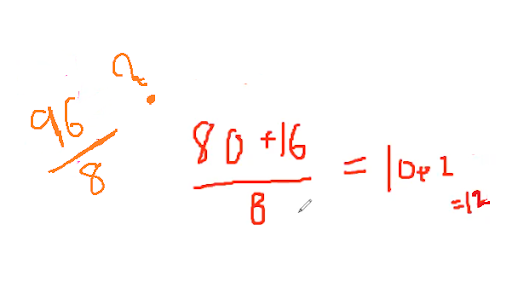
And we verified that this answer is correct because she knew that 12 x 8 = 96.

So now it was my time to play the Devil :)

"I have a doubt.... "  and while saying this I started doing the same what she did some time back - striking off some numbers while telling the times table :)

"8 x 1 = 8 and 8 x 10 = 80.... So the answer is 10 + 16 = 26"

No wonder she was stunned at this :)  But then she also quickly, independently & happily realized as to what I wanted to convey to her through this example...

She said that both the numbers in the top have to be divided by the same number in the bottom...

She was also satisfied with x + y = 43 now :)

But then I was not yet done... How can I miss this beautiful opportunity to make another important point ?

I asked her -

"Yes , sometimes we certainly work the way we did - striking off the numbers in the top and the bottom while telling their times table... But why did that method not work well in these problems?"

After thinking for a while, she said -

"May be it works when there are 2 numbers in the Denominator"

Again please PAUSE and think about this guess of hers... What could have made her think of such a possibility ?  ;)

....

....

....

...

So she worked out this way on the board (splitting 8 as 4 + 4 in the bottom) with high hopes !

But soon she was disappointed by the result she got (24, as against the expected 12)

I again gave her some time to ponder over, but since there was no response I thought it would be better idea to give her more to play with on this idea after our class...   And she happily agreed to work on it by the next session...

And I am now eagerly waiting to know from her :)

1) Let me know if you too would like to know as to what happened on this matter...

2) What were your thoughts while reading this post, esp. at the instances where I suggested you to Pause and think about your strategy to move ahead ...

3) How about trying out such a conversation with your students / children ?

4) Did this post remind you of something / similar experience?  Plz share...

5) What could be the possible reasons of misconceptions of the student?  Have you also experienced difficulty dealing with the same topic in your class (evaluation a fraction with more terms in the top and one or more terms in the bottom)? How do you deal with that ? How well has your strategy worked? 

6) Your comments about the method I adopted ?

I will be happy & thankful to you if you share your responses to (at least some of the) queries above :)


Thanks and Regards

Rupesh Gesota

www.rupeshgesota.weebly.com

Monday, October 21, 2019

Part-2 : Re-learning and Enjoying Polynomial Division with students.


Last week I had shared my classroom experience of working with students on polynomial division, and these students were not yet taught the standard procedure of solving such problems in their school. This is the link to the blog: 


I forgot to mention one more interesting thing that happened while working on this problem, which I think would be worth sharing - esp for in-service maths teachers.

Before the two students (mentioned in the above / previous post) shared their solutions, another one had come up with this one :

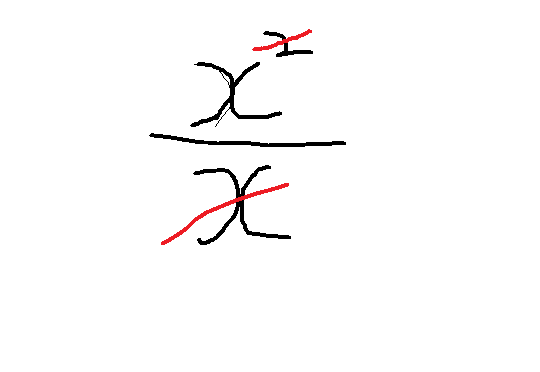
Now, this mistake would not be new to the teachers who have been teaching algebra since long. Its one of the most common mistakes which would be done by at least one student in the class every year. I don't get irritated by these mistakes. I desperately wait for such mistakes. Yes ! Because I think it is a golden opportunity for the teacher if he / she is able to spot a student thinking / working this way. It presents just the right context and time for driving an enriching mathematical conversation in the whole class -- to know what other students think about this, if such misconception is simmering in someone else's mind too (& hence it would be nipped in the bud itself though the subsequent talk) and most importantly to know how my students see this / argue about this. 

Do they say that -- 
a) This work is incorrect because it cannot be done this way. It is a rule! OR 
b) Do they really reason about it, with proper math ?

When this student (S1) solve this way on the board, I was a little surprised as to why he did not 'cancel out' another 'x' too in the numerator (there was one in the term 3x too)  and why he did not work with 10 and 2 in the same way?  :)

I was about to argue (confuse) him by asking these, and when another student (S2) stood up - It is not possible to do this way. 

On one side, I was a bit disappointed as he had foiled my plan (of confusing A), but on the other side, I was also happy that there was another student in the class who could spot some 'non-sense math' and object about it :)  S1 was surprised by this remark of S2. 

S2 went to the board and argued - How can we divide x^2 alone by x.... We have to first add the terms 3x - 10 to x^2  and then divide this sum by the expression in denominator. 

Pause for a while and think what's your take on this argument.

---

While I was glad that he had noted and argued well about one aspect, I was not sure if he has missed or overlooked another important fact  --- that it was not just a single 'x' term but a binomial 'x - 2'  in the denominator (divisor). I was for sure going to delve into this matter in some time, but first I was curious to know how other students react to this argument of S2.

Almost all of them understood what he said, except couple of them. So he gave this example - 

     12 + 5 
   ------------      
        3

12 / 3 = 4 . So can we say the answer of above expression is 4+5 = 9?  

No, they replied. It is 17/ 3 which is 5 point something.....

And this was just enough to convince the ones who had not understood.

Wasn't this a fantastic creation?  and that too made spontaneously ;)

--------

And now, it was my turn -- to play villain ;-))

Remember I stated my concerns above - I was not sure if S2 is also aware that S1's simplification was incorrect because of one more reason. (there is -2 sitting with x in the denominator)

So I asked them - But what if the question did not have more terms in the numerator? means, what if the question had just x^2 term. 
I intentionally looked at S2 - Now, it would be okay to 'cancel out x' right ?

He was perplexed.... I was right when I was doubting about this part.... He had not considered this aspect yet...

But interestingly another student S3 jumped in and said - No !  We cannot do this.

Why?

Because we have to divide x^2 by (x-2)  &  in the above case, we are dividing x^2 by only x. 
It is like -- The question is to divide 20 by (6-2) , and we are dividing 20 by 6 itself.... So the answer obtained will not be correct. 

Fantastic !!

But I cannot give in so easily ;)

Is there any other way to prove that this is incorrect?

S2 bounced back.  -  'Let us multiply the Numerator and Denominator of the answer by 'x'  and see if we are getting the given fraction back.'


Since we are not getting the initial (given) fraction back, it means we have solved it wrong way. 

He left me speechless. This thought deserved appreciation, isn't it?  

But I responded to it with (an imp) finishing question - So will we ever be able to do this type of division?

Yes, we can do it - but only when there is no addition, subtraction in the numerator and denominator. Only when there is one term on both the sides. And while saying this, he happily showed did this on the board !

And the Devil in me had started cooking this type of situation now....

However, they had already gone into the celebration mood by now (winning against me), and so I thought to reserve this bouncer for the next match :)

-------

a] Do let me know your views / comments about this post. Would be glad to know 4m you...
b] And how would you respond / do you respond, when you see your students demonstrating such (common) algebraic misconceptions? 


Thanks and Regards


PS: Students belong to class-7 marathi medium government school in navi-mumbai. I work with them voluntarily after their school hours as a part of maths enrichment program. www.supportmentor.weebly.com

Saturday, October 19, 2019

Re-learning and Enjoying Polynomial Division with students.


They had just learned how to multiply two linear binomial expressions like 
(x + 2).(x - 5) , (3x - 2).(5 - 4x) , etc. in two ways -  pictorially as well as symbolically (i.e. by expanding).

I now wanted to see their approach for the division problems, like for problems of the type:
(x^2 + 5x + 6) / (x + 2)

Polynomial division was not yet taught to them in their school. So I should have first given them a simpler problem like the example above (all +ve terms), however for some reason I directly pushed them into the challenging zone this time. This was the problem I gave;

(x^2 + 3x - 10) / (x - 2)

I would suggest you to pause and think for a while - to assure yourself as to why this could be a little difficult problem, esp for those who do not know the procedure to solve this... See if you can solve this problem using a way which was not taught to you :)

-----

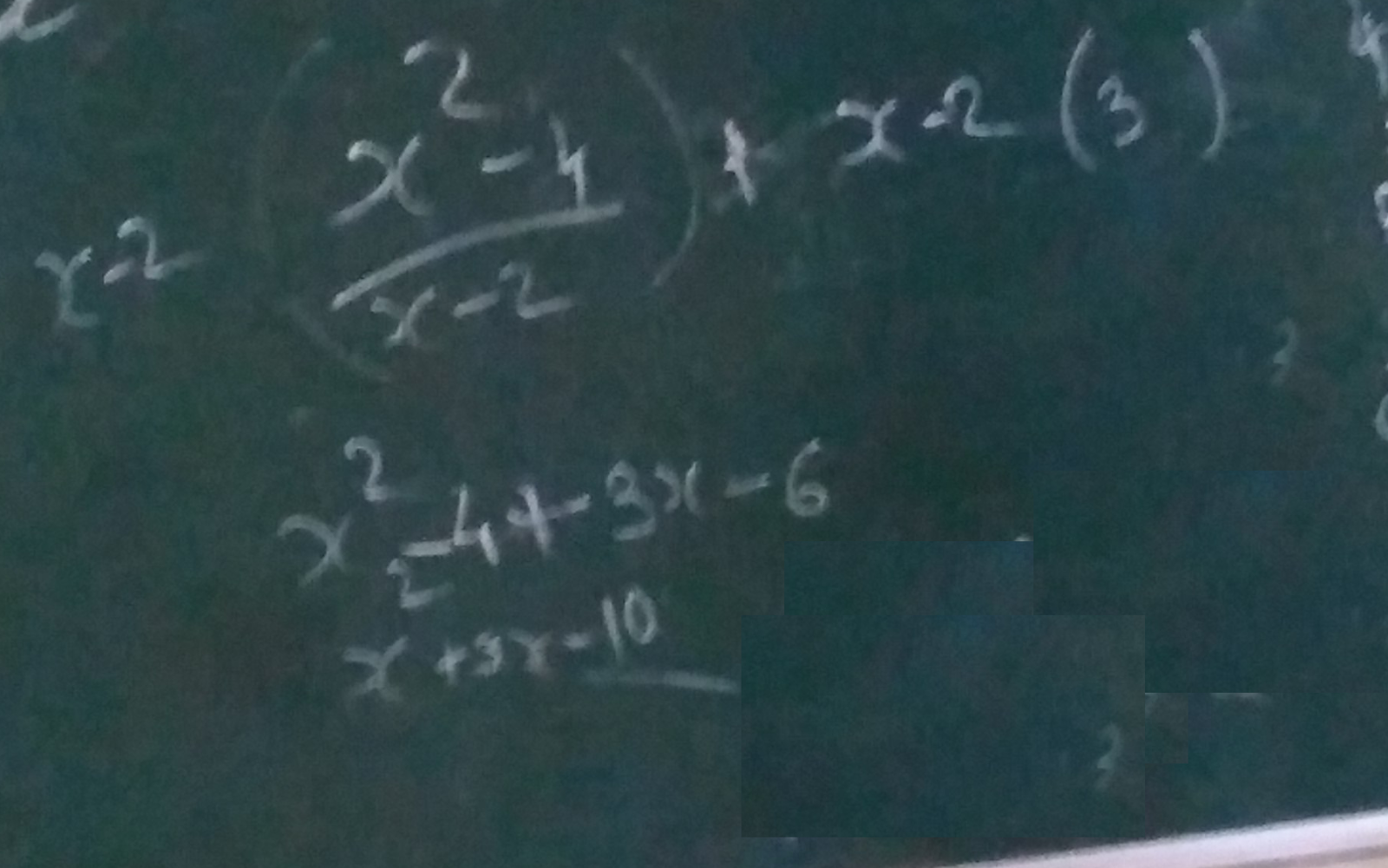
After some time, one of them came to me and showed me his final result. He said it is 3 wholes and (x^2 - 4) / (x-2) . I must confess at this moment that I was completely surprised by such an answer. And I wonder if you too would expect or have seen the quotient of polynomial division in such a form. 

I suggested him to go and explain his approach on the board for others to know. And this is what he did -

Note his diagrammatic representation for the expression (x^2 + 3x - 10) . The ten small shaded circles represent negative ten. Then he explained -

We need to divide  (x^2 + 3x - 10)   by  the expression  (x - 2)  , which means we need to find out how many (x-2) are there in (x^2 + 3x - 10). 

Looking at the terms 3x and -6, we can see that (x - 2)  is present 3 whole number of times in this expression. So what is left now is (x^2 - 4),  which when divided by (x - 2) will give us  (x^2 - 4) / (x - 2). 

When one of the students did not understand this, he gave an explanation using a numerical example of 4 / 3 (he did not fully write the long division process till the end (remainder=0), but he explained the process well verbally).

Everyone agreed with this result. I asked them if we could verify this, to which one of them said - Yes, we can multiply and check. And this is what he did. 


It was an Aha moment for me!  What about you?  :-)

Now, there was a student who said that he had got a different answer. Others were surprised by this remark. He was asked to come forward and explain his approach.

This is his work:


- We need to find out (x-2) multiplied by what will give us (x^2 + 3x - 10)

- Since there is one x^2 term, it means that the multiplier of (x-2) should have at least one 'x' term..[ while saying this, he wrote 'x' next to (x-2) ] 

- Now, multiplying this 'x' by (x-2)  gives us x^2 - 2x

- But we need +3x  and not -2x.... So we need to add +5 to this multiplier 'x' so that this +5 after multiplying by 'x' of the expression (x - 2) gives +5x , which after combining with the -2x we have, will effectively yield the desired +3x  [while saying this, he wrote +5 next to 'x']

- Further, this +5 and -2 will multiply to give -10 too...So the answer is (x+5)

I looked at everyone and they were already with him. Before I could ask him about verification, he had already begun -


"So is the movie over?", I asked them with the hope that they should loudly say - NO.

And yes, they did not disappoint me :)

"Why not?", I ask them.

We now need to prove that both these answers are same.

"Oh is it? Why can't these 2 answers be different ? We have seen problems having multiple correct answers", I continue probing them as if I was unaware of whats going on in their mind.

Sir, how can division of the same set of 2 numbers give different answers?, argued one of them.

"Hmm... But these 2 expressions look completely different,", - my counter.

Yes, but then they should be equivalent....  

"Have we seen such cases earlier ?"

Yes, many times.., came their quick reply. 

I felt a sense of accomplishment with this conversation... So now their goal was - 


I doubt if we have seen a T.P.T. algebraic statement of this form in any textbook  :)
Thanks to my students, they keep offering me numerous wonderful learning opportunities !

Do not hesitate in pausing for a while, trying to prove this on your own first. 

-----

People with some algebraic knowledge will mostly and quickly factorize the expression in Numerator as (x+2)(x-2) and 'cancel off' one of the factors viz. (x+2) with the expression in Denominator...  But would this exercise leave us with (x+5) as desired  ?

And before you say yes, let me just tell you that these students are Not even aware of this identity of difference of squares [ a^ - b^2 = (a+b)(a+b) ], which we could instantly see and use. 

So then how would they go ahead??

Yes, that's the interesting part which even keeps me on toes while I work with them. 

I saw that they were just staring at these expressions for some time. I thought that I should intervene and offer them some clue and I did that. But soon I realized that I was wrong in doing so. 

I asked them "what does the expression on the left look like?"

They said, it resembles a Fraction. 

"Yes, and what about the one on right side"

They said, it looks like a Whole number.

When asked for the reason, they said - RHS expression (x+5) has the denominator=1.

"So what do you think, what should happen in the left side expression?", I ask them.

One of them quickly said, (x-2) should be factor of (x^2 - 4)... 

And why so ?

Only then its denominator will go away. 

While I was about to relish with this thought process, meanwhile one of them was already scribbling something on the board and he interrupted us ...

Sir, it is proved.... both expressions are equal !... he exclaimed in delight.

Oh wow !!  I felt a bit tempted to correct his vocab.... but that was not so important now....


Just study the left side of his work above. What he saw and said is - 

We need to prove the left expression to be equal to x+5.....Now, there is already a 3 in the left side expression.... So this means that the fractional part of this left expression should get simplified to x+2,  so that this when added to 3 wholes, will give us x+5 as desired.

He further continued.... 

So then I checked whether the fractional part is really equal to x+2 or not. 

'How?'

I multiplied (x-2) and (x+2).... and we get x^2 - 4. .. After factorizing the Nr., we can divide both Nr. and Dr. by the term (x-2)  and then we will be left with (x+2),  which when added to 3, gives us (x+5) as desired.

------------

To this, another student joined us, saying even he has proved both the expressions equal, but has used a little different method to get x+2.

I thought whether the Dr. is equal to the square of Nr. i.e. whether (x^2 - 4) = (x-2)^2  ?
But then I noticed that after multiplying (x-2) by (x-2), I will get  +4  and not -4 as desired in the expression (x^2 - 4) ..... So I changed the sign of 2 of one of the x-2, making it x+2..... And then when I multiplied these two terms (x-2) and (x+2), I got  (x^2 - 4)......  And then I did same as what he has done (above method) to get x+5.

-------------------

I could clearly see that the sense of wonder and accomplishment of proving the equivalence of two resulting expressions, obtained from their two different approaches - gave them more joy, satisfaction and confidence than the answer of the main (division) problem...

What do you think, would have happened if I had directly showed them or given them the procedure of dividing the polynomials as given in textbooks?  How would your students see / solve this problem if you don't give them the ready-made recipe ?

Will be eager to know your views and comments on this piece...

Thanks and Regards


PS: Students belong to class-7 marathi medium government school in navi-mumbai. I work with them voluntarily after their school hours as a part of maths enrichment program. www.supportmentor.weebly.com